Learn how annuals and perennials behave and discover what wildflower mixtures can help achieve the required results.
Annual Wildflowers
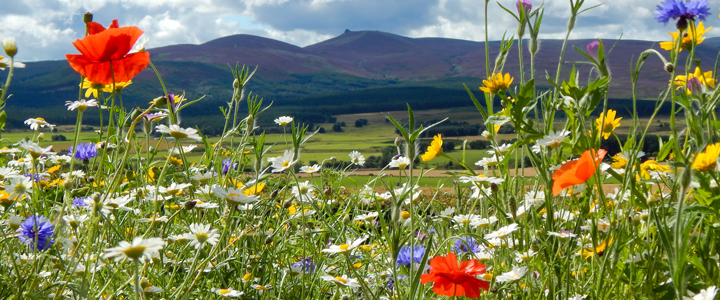
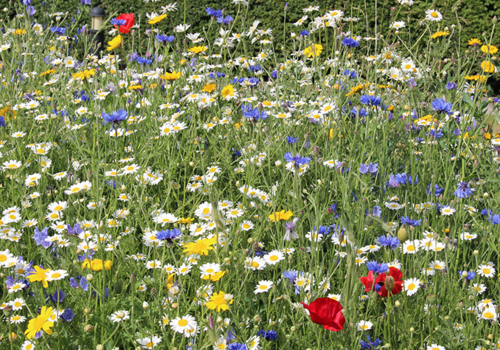
Annual wildflowers are popular due to their ability to establish, flower quickly and display splashes of bold colours that look spectacular. However, they can be a single season wonder if maintenance is not carried out. This is because annual wildflowers use all their energy to create beautiful blooms, then as they die off, they set seed to grow the following year, but the process is not perfect. Specific steps need to be carried out over several seasons to create a minimal maintenance annual wildflower display.
Annual Wildflowers - the First Year
Annual species are fast to establish and flower. After flowering, the plants will naturally die back over the winter. Allow the plants to seed in autumn then cut the area down using a scythe, strimmer or mower, leaving the cuttings for up to a week before clearing the area. This will allow them to dry and shed seeds back into the soil. Then, use a roller or your wellies to split the seed heads up to enable more seeds to get into the ground. This will result in a full annual showing in the following year.
Annual Wildflowers - the Second Year
Depending on your sowing preference, cultivate the ground and reseed in September or March. Over several seasons of repeating the above process, a fertile seed bank will develop and simply disturbing the soil through digging or rotovating will be sufficient to regenerate the flowers each year.
Annual Wildflowers - A Summary
- Produce bold and colourful blooms
- Can establish and flower within 60 to 80 days when sown in the spring
- Have longer bloom times than perennials
- Attract and help pollinators
- Will only flower for one season if left unattended
- Require maintenance
Perennial Wildflowers
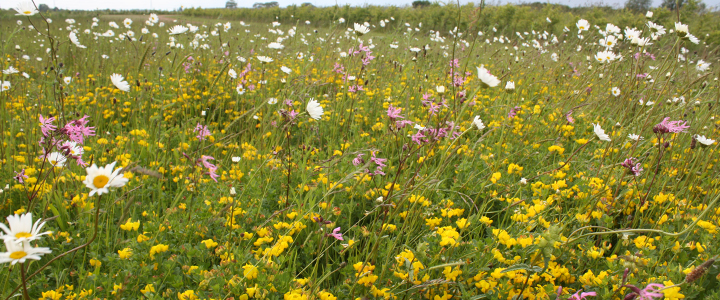
While Perennial Wildflowers do not have the same visual impact that annuals have, they do last a very long time with less maintenance required than annuals. Perennials are an excellent choice for larger areas as they still attract and help butterflies, bees and other pollinators.
Perennial Wildflowers - the First Year
Perennial species can be slow to establish and are unlikely to flower in the first year. The area can be cut once the flowers have died back in the autumn, but we recommend leaving the area undisturbed for as long as possible, ideally until February / March (before the first spring growth). When the area is left, dead flowers and stems provide a diverse environment which is a haven for wildlife through the winter months. In particular, it provides habitat for butterflies such as the Red Admiral and the Clouded Yellow which remain in their chrysalis during the winter months. Cut the area down to 10cm using a scythe, strimmer or mower, leaving the cuttings for a week before removing. This will allow them to dry and shed seeds back into the soil.
Perennial Wildflowers - the Second Year
After twelve months, the sward should be well established and require little additional maintenance. Then, follow the same annual cut pattern (either in spring or autumn depending on your preference). Over time, some species within the mixture may become more dominant due to environmental factors and natural selection. To encourage diversity, reduce the number of dominant plants to restore the balance.
Perennial Wildflowers - A Summary
- Return year after year
- Are low maintenance
- Attract and help pollinators
- The first season after sowing will not produce a great display
- Appearance improves every season
- Have shorter bloom times than annuals
Perennial Wildflower and Annual Wildflower Mixes
We have created Wildflower Mixes 100% that will provide the best of both worlds to ensure that annual blooms are produced in the first season after sowing, followed by perennial wildflowers in subsequent seasons.